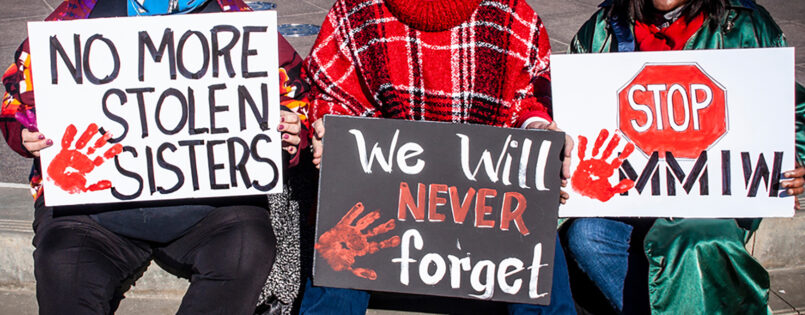
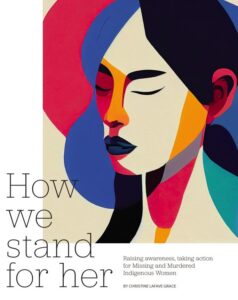
Raising awareness, taking action for Missing and Murdered Indigenous Women
By Christine Lafave Grace
The statistics are startling: More than 4 in 5 American Indian and Native Alaskan women—a staggering 84.3 percent—have experienced violence in their lifetime, according to a research report published by the U.S. Justice Department’s National Institute of Justice. Among those who reported being victimized, 55.5 percent said they had experienced physical violence by an intimate partner, and 56 percent said they had experienced sexual violence.
Indigenous women have gone missing at rates higher than any other U.S. demographic group. Homicide is among the five leading causes of death for Indigenous girls and women in both the 10 to 24 and 25 to 34 age groups.
Yet consistent reporting on Missing and Murdered Indigenous Women (MMIW) at the federal level is scarce. What’s more, MMIW reporting and research has focused primarily on Indigenous women living on tribal or federal lands, even though a 2017 Urban Indian Health Institute (UIHI) report noted that about 70 percent of American Indian and Alaska Native women live in urban areas. Information-sharing across investigating agencies has also been inconsistent. UIHI recorded that of 5,712 cases of MMIW reported in 2016, only 116 were logged into a Justice Department database.
Two issues— the long history of underinvestment in research around women’s health and Indigenous persons’ health, and mainstream media’s historic underreporting of missing-persons cases when the missing person is a non-white woman— have exacerbated the lack of visibility into MMIW as a public health crisis. And so, many communities that are predominantly white or non-native continue to lack of awareness of the crisis of Missing and Murdered Indigenous Women, Girls and Relatives.

On May 5, the ELCA joins with other faith traditions, civic communities and concerned individuals across North America in recognizing Missing and Murdered Indigenous Women Day and encouraging education and action on behalf of MMIWG/R.
“I don’t want to live in a world where you have to lose people to make it relevant,” says Prairie Rose Seminole, a citizen of the Three Affiliated Tribes of North Dakota and the American Indian Alaska Native Program Director for the ELCA. “But that’s the same with anything—look at climate justice, all of these things—people are dying, and sometimes that’s what makes it relevant for people.”
She adds: “We see so many conversations around, ‘I didn’t know this existed; I didn’t know this was a problem in my state. I didn’t know that in my sleepy town in California, (human) traffickers come through here, because we’re a sleepy town.’”
Seminole, a lifelong ELCA member descended from the Arikara, Northern Cheyenne and Dakota nations, frequently visits ELCA congregations across the country to help facilitate conversations around the MMIW crisis and how congregations and individuals can take action. In Women of the ELCA’s “We Stand for Her” resource guide, Seminole writes: “For me, storytelling is faith in action. In the ELCA, we believe in accompaniment, the practice of walking alongside people in their joys and their struggles. This is the heart of the MMIW movement: bearing witness, standing in solidarity and refusing to turn away from the violence and injustice that have stolen so many lives.”
Seminole can share too many personal experiences with such violence and injustice. Her aunt was killed on a gravel road in North Dakota; no investigation followed. Her niece was fatally beaten and died on the steps of a relative’s home. Multiple male relatives also have been murdered.
In 2024, Seminole co-directed “We Ride for Her,” a 20-minute documentary on the Medicine Wheel Ride, an annual two-week ride by a grassroots group of women motorcyclists to bring attention to the MMIW crisis. The ride ends in Sturgis, South Dakota, to coincide with the world’s largest annual motorcycle rally, held in Sturgis each August.
“We Ride for Her” has been screened across the country, including at many WELCA events. Strong audience interest and support allowed Seminole to begin work in 2025 on a feature film about the riders—why they ride and whom they’re riding for.
“Everybody’s at a different point of learning,” Seminole says. “But I feel really proud [that] folks are starting to show up where they can, when they can… That matters.”
Advocating to end human trafficking, find those who are missing, and prevent future violence, begins with understanding and “evolves into a connection to what people can do within their reach,” Seminole says. People may be “showing up for a missing-person search—showing up by raising money, sharing a poster on Facebook, electing people who will make a difference. There are so many different layers and ways people can show up.”
“We Ride for Her” screenings have brought in contributions for both the Medicine Wheel Ride and the ride’s mutual aid network, which provides critical, personalized assistance to the families of missing and murdered people.
Seminole says there are many ways to get involved. We can donate in response to critical and evolving needs, host educational sessions that help people identify and respond to human trafficking, and advocate for policy changes that support inter-agency collaboration on missing-persons cases. “Those pieces add up,” she says, “and folks make a difference when we’re working in the same direction.”
 MMIW: What can you do?
You, your group and your congregation can grow awareness and get involved by visiting the Gather website (www.gathermagazine.org/MMIW) for downloadable print resources, videos, a book discussion, a candlelight vigil, links to religious and secular organizations, and more.