
By Contance Mudore
Waving leafy branches and whooping in excitement, a large group of women dressed in kangas (colorful traditional clothes from East Africa) greeted us. We had finally arrived at the village of Merya, in the Singida region of central Tanzania. Is this the kind of welcome Jesus received when he entered Jerusalem on Palm Sunday? I wondered.
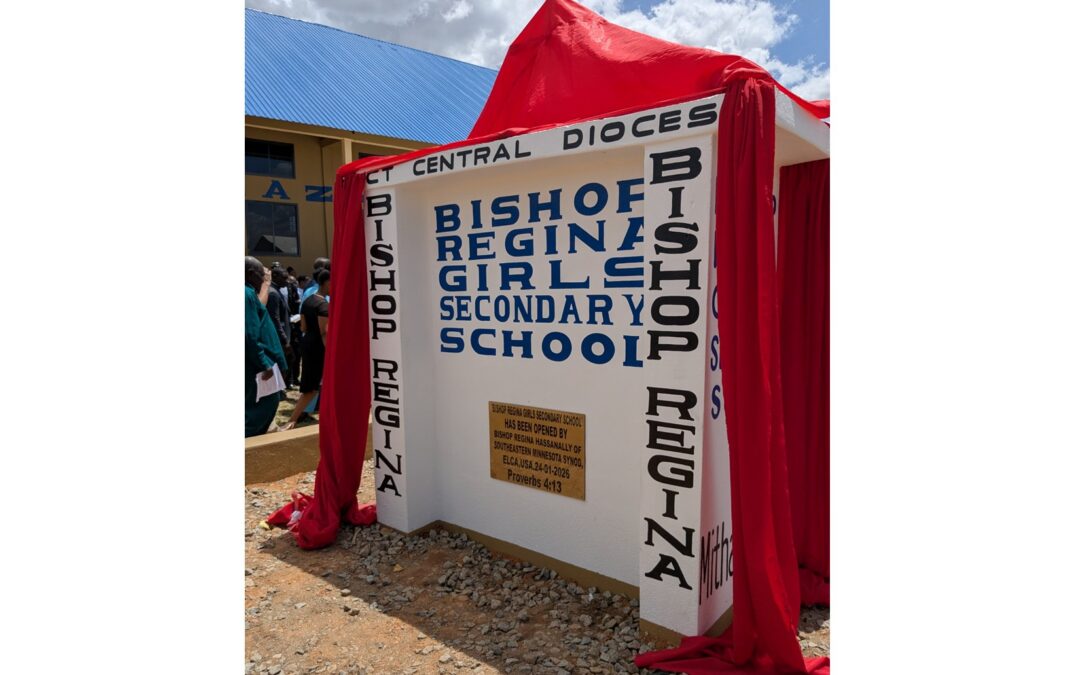
I was one of 11 church representatives who traveled to the Central Diocese of the Evangelical Lutheran Church in Tanzania (ELCT) with Bishop Regina Hassanally of the ELCA’s Southeastern Minnesota Synod. We were there to visit a number of mission partners and projects. It seemed like an ordinary trip to nurture global companion relationships. However, one event on our itinerary wasn’t ordinary at all. During our visit to Singida, a new girls’ school would be dedicated in Bishop Hassanally’s honor. Called the Bishop Regina Secondary School for Girls, it would soon open and serve 160 students.
Despite a popular Tanzanian proverb which states, “When you educate a girl, you educate a nation,” women lag behind men in Tanzania when it comes to literacy. Women’s status, due in part to their limited earning power, is low. Domestic violence, particularly related to a male partner’s alcoholism, is high. An estimated 50 percent of women who are (or have been) married experience violence at home. (The global average is 30 percent.) Gender-based inequality is a challenge for societies around the world. As society members, churches struggle with it as well. The ELCT is no exception. Although the ELCT has ordained women for three decades, as of early 2026, there have been no female bishops.
During a private meeting, our delegation asked Bishop Syprian Hilinti of the Central Diocese what he had in mind when selecting the name of the new school.
“Bishop Regina has fostered an ongoing supportive relationship with the Central Diocese over the years,” he said. The dedication recognized and honored that relationship. The bishop added: “What would it say if we named a girls’ school after a man?” By naming the school in honor of a female bishop, he was sending a message. It was time for the Lutheran church in Tanzania to imagine a new role for women.

Hundreds of people, including many dignitaries, attended the dedication and opening. The celebration featured singing, dancing, feasting, and of course, speeches. The Honorable Halima Dendego, a member of the Tanzanian Parliament said in her remarks: “Make no mistake! This dedication is important to the advancement of women in Tanzania.”
Curious to know what it meant to a woman who wasn’t a dignitary, I spoke with the Rev. Rehema Gwao, manager of the Central Diocese Lutheran Center complex in Singida. The complex includes a religious bookstore and a pharmacy that serves dispensaries affiliated with the diocese.
“Women can do anything men can,” Rev. Gwao said. “Yet there have not been any female bishops in our country. Naming a new school for a female bishop gives us women hope. Your bishop was the first woman to become a bishop in your diocese. There will be a first here too.”
Constance Mudore is a writer from Rochester, Minnesota. She has visited 36 countries. A retired school counselor and chaplain, Constance is an active member of Mount Olive Lutheran Church.
This article appeared in the Fall 2026 issue of Gather. To read more like it, subscribe to Gather.