

Just as my wife, Marlene, and I were about to travel to Ireland for a sabbatical, my father-in-law was nearing the end of his life. At 89 years old, struggling with a blood disorder and the side effects of the prednisone that had kept him alive, his body began shutting down. He entered hospice. Three days before our sabbatical began and three weeks before we were to travel to Ireland, he died. Marlene was by his side.
It was a sad time for our whole family. For Marlene-an only child whose mom was already deceased-it was especially challenging. But we discovered as we lived through it that the timing of his death and of our sojourn in Ireland proved to be healing and holy.
The first task for our sabbatical was to provide closure for essential parts of his affairs. I won’t share all that we did to prepare for his funeral, dispose of his belongings and get ready for our trip, but one task that proved more important than we initially thought was selecting funeral flowers. Marlene wanted just the right flowers for her dad. It took a lot of wrestling before she finally agreed to have calla lilies.
Fast forward three weeks. We’d ordered the calla lilies, traveled to Iowa for the funeral, cleared the apartment of his possessions and packed for Ireland. Though this was hectic and emotional, we’d gotten it all done. Finally, we boarded the plane to spend a month in Ireland.
Across Ireland, there are many shrines and memorials to remember 1,600 years of history and the saints who walked and shaped the land. Every town, every ancient abbey and convent, and many shrines and memorials are connected to cemeteries. I enjoyed walking through the old cemeteries, finding a quiet peace in places replete with history, gravestone art and a sense of connectedness.
Over the course of the month, we stopped at dozens of these old cemeteries. Some graves were hundreds of years old, far older than any gravestones I’ve found in the United States. While we experienced many things in Ireland, to my mind, everything somehow directly connected with our time walking in cemeteries.
Celtic Christians are very intentional about the directions of their graves. Every grave is prepared so that the body is laid in the ground facing east. East is the direction of the rising sun and the traditional symbolic direction of watchfulness for the second coming of Christ. Each person is placed in a grave not just to rest, but also to anticipate his or her own resurrection at Christ’s return.
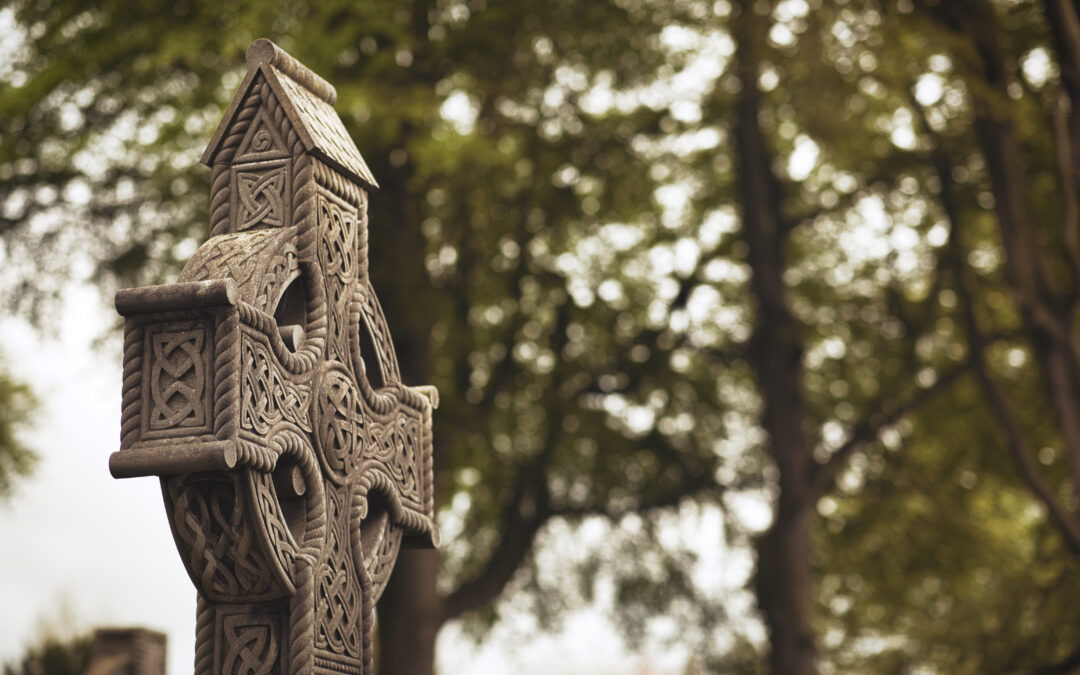
The most prevalent grave markers are forms of the Celtic cross-a cross often decorated with Celtic knots or other images. The cross is laid over a circle background that represents the sun.
Prior to Patrick’s arrival in Ireland (St. Patrick was not Irish, but an English missionary to Ireland), the religions of the people there were heavily focused on creation. The sun was viewed as especially sacred. Tradition has it that the Celtic cross was developed by St. Patrick as an evangelizing tool. The remote nature of the British Isles allowed Christianity to grow there with fewer requirements for conformity. While most evangelism efforts on the European continent included a commitment to eradicate pagan beliefs, in Ireland the people’s love of creation was incorporated into a creative and vibrant theology uninhibited by constraints often put in place by Rome.
Look closely at the image of the Celtic cross. Do you see how the sun is cast behind it? This is not an image of the sun with a cross inside. This is the cross, standing at the center of creation. Celtic Christianity did not try to beat the paganism out of the Irish, but rather attempted to place the things they valued in a new light. The created world, so important to the Celts before they encountered Jesus, continued to be significant. But what transformed their worldview was not simply affirming the created order, but recognizing that the cross of Jesus has redeemed and brought new life to all of creation. Rather than tossing out the people’s emphasis on creation, Celtic Christianity was intentionally built upon it. If there is any symbol for Christianity with both a historic and a present concern for our environment, the Celtic cross seems to be it.
Unknown to us when Marlene selected her father’s funeral flowers, the Irish climate is perfect for calla lilies. They were in bloom in gardens and on graves all across the island. The choice Marlene had fretted over in order to honor her father echoed over and over again in so many places throughout our journey. Wherever and whenever we saw the lilies, they were a soothing reminder of God’s healing power-as comforting and encouraging as words from God. Today our picture of calla lilies in Ireland hangs over the piano in our living room, continuing to remind us of Marlene’s father, our trip to Ireland and God’s goodness and grace.
As I walked through one cemetery, my wife wandering up ahead, I was deep in thought, noting the long shadows and the smells of the earth, the grass, the sea and even the moss. Suddenly I sensed God speaking to me. God gently said: “Someday your body will return to the earth, and you will be laid to rest in the ground.” In the midst of this mystical encounter with Christ, I suddenly found myself looking forward to my own eventual death in a new way that felt hopeful and life-giving.
St. Patrick’s Ireland is often viewed with a bit of awe and mystery. Its deeply rooted Christian heritage has an independent streak that offers contemporary pilgrims surprising new ways to experience God’s goodness. Just as St. Patrick used nature and the cross to share the gospel with the Celts centuries ago, calla lilies and the Celtic cross unexpectedly offered my wife and me a reminder of God’s goodness and God’s call to new and healing ways to love the world that God made.
Dave Daubert Is lead consultant for Day 8 Strategies, doing church leadership and renewal work across the U.S. He and his wife, Marlene, a rostered deacon, share leadership at Zion Lutheran Church in Elgin, Illinois.
This story appeared in the March 2019 issue of Gather. To read more like it, subscribe to Gather.